Categories
How To Make Money Online

Why Haven’t I Made My First Affiliate Sale? 9 Hidden Reasons (and How to Fix Each One)

You’ve done the work. You picked an offer, built a page, maybe even bought some traffic. You check your affiliate dashboard in the morning, at lunch and one last time before bed. And every time, it says the same thing: $0.00.

At some point, a question starts to creep in, quietly at first and then louder: Why haven’t I made my first affiliate sale? Is it the offer? The traffic? Is it me?

Here’s what I’ve learned after years of building my own affiliate business, including a long stretch between 2023 and 2025 where I nearly quit more than once: it’s almost never you. It’s almost always one broken link in a simple chain. Find that link, fix it, and the first sale usually stops being a mystery.

In this guide, I’ll show you how to diagnose your funnel in about 15 minutes, walk through the 9 hidden reasons most beginners don’t make that first sale, and give you a practical fix for each one.

Quick answer: If you’re asking “why haven’t I made my first affiliate sale,” the most common reasons are sending traffic straight to a sales page, using low-quality traffic, having too few follow-up emails, pitching in every email, poor email deliverability, an offer that doesn’t fit your audience, and not giving your funnel enough time or volume. Check your opt-in, open and click rates to find the weakest step, then fix that one thing first.

Before We Continue

If you keep asking yourself why haven’t I made my first affiliate sale, know this: being stuck at zero is a lot easier to fix when you’re not figuring it out alone.

That’s why I send practical emails to people in exactly this spot: the funnel fixes that moved my numbers, the traffic sources I’m testing, simple email ideas that get clicks, and honest notes on what didn’t work. Think of it as a second set of eyes on your funnel, delivered to your inbox.

Short, useful and never pushy.

Click here to get simple fixes that help you get unstuck and closer to your first affiliate sale.

Why haven't I made my first affiliate sale: 9 hidden reasons and fixes
Why haven’t I made my first affiliate sale? Usually one broken link is to blame.

Part 1: The Diagnosis

Why Haven’t I Made My First Affiliate Sale? The Short Answer

Because somewhere between a stranger seeing your content and that stranger buying, the chain broke. Every affiliate sale depends on a short sequence of steps working together. When even one of them is weak, the sale doesn’t happen, no matter how hard you’re working on the others.

Most “No Sale” Problems Come Down to One Broken Link

Beginners often try to fix everything at once: new offer, new page, new traffic, new emails. That makes it impossible to know what actually helped. In my experience, most stalled funnels have one main bottleneck. Fix that, and results often start moving even if everything else stays the same.

The 4-Part Chain Every First Affiliate Sale Depends On

  1. Offer: a product that solves a real problem for the people you’re reaching
  2. Page: a capture page that turns visitors into email subscribers
  3. Follow-up: emails that build trust and recommend the offer at the right time
  4. Traffic: real, interested people arriving at your page
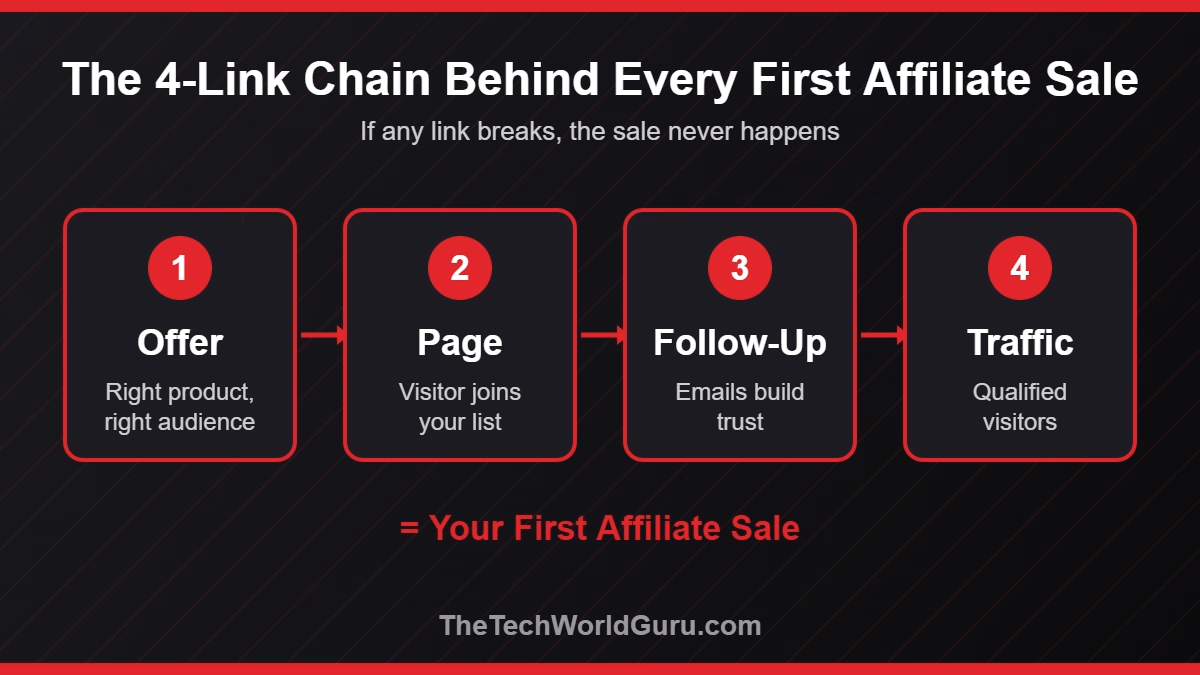
Why haven't I made my first affiliate sale: the 4-link chain of offer, page, follow-up and traffic
Why haven’t I made my first affiliate sale? Check each link in this chain.

How to Find the Weak Link in Your Funnel in 15 Minutes

Before changing anything, look at your numbers. Your traffic source, page builder and autoresponder already give you everything you need.

Reading Your Traffic, Opt-In, Open and Click Numbers

Write down four numbers for the last two to four weeks: visitors to your capture page, new subscribers, email open rate and email click rate. Then compare them to the table below.

A Simple Diagnosis Table: Symptom, Likely Cause, First Fix

SymptomLikely causeFirst fix
Very few visitorsNot enough trafficIncrease volume from one tested source
Visitors but few opt-insWeak capture pageRewrite the headline and lead magnet promise
Subscribers but low opensSubject lines or spam folderTest subject lines and check deliverability
Opens but low clicksWeak email contentTell a clearer story with one call to action
Clicks but no salesOffer fit or traffic qualityCheck audience match and lead quality

Find the first row that describes you. That row is usually the real answer to “why haven’t I made my first affiliate sale?” in your own funnel, so that’s where to start. The 9 reasons below explain each problem in more detail.

Part 2: 9 Hidden Reasons You Haven’t Made Your First Affiliate Sale

Why haven't I made my first affiliate sale: 9 hidden reasons checklist
Why haven’t I made my first affiliate sale? Start with these 9 hidden reasons.

Reason 1: You’re Sending Traffic Straight to a Sales Page

How to Tell If This Is You

This is the most common answer to why haven’t I made my first affiliate sale. You paste your affiliate link into posts, ads or solo ad orders, and visitors land directly on the vendor’s sales page. You have no email list, or a very small one.

The Fix

Send traffic to your own capture page first. Most people don’t buy on their first visit, and without their email address, they’re gone for good. A capture page lets you follow up for days or weeks, which is where most first sales actually happen. My guide to building an email list from scratch walks through the setup.

Reason 2: Your Traffic Is Cheap but Not Qualified

How to Tell If This Is You

You’re getting lots of clicks or subscribers, but almost nobody opens, clicks or buys. You chose your traffic mainly because it was the cheapest option.

The Fix

I learned this one the hard way: cheap clicks don’t automatically mean good leads, and a subscriber isn’t automatically a buyer. Test traffic sources in small batches, track opens, clicks and sales for each one, and keep only what performs. Today, My Lead Gen Secret and Twice Confirmed Traffic together bring me around 20 front-end sales every month, but that came after a lot of testing and dropping sources that didn’t work.

Reason 3: Your Capture Page Promise Is Too Vague

How to Tell If This Is You

Plenty of people visit your capture page, but your opt-in rate is low. Your headline says something general like “Free Tips” or “Join My Newsletter.”

The Fix

Make the promise specific and connected to your offer. “The 5-Step Checklist for Your First Online Sale” will usually beat “Get My Free Tips.” When I started building and testing my own capture pages instead of relying only on default templates, my opt-in rates improved noticeably on the same type of traffic.

Reason 4: You Don’t Have Enough Follow-Up Emails

How to Tell If This Is You

New subscribers get one or two emails, then nothing. Or you only email when you remember to.

The Fix

Build an automated sequence. A simple start: a welcome email, a story email, a quick-win email, an offer email and an objection-handling email, then keep adding over time. In my business, non-buyers go through a roughly 30-day follow-up sequence. The first course I ever took, the eFarming Challenge, taught me that the follow-up is where the money is, and it’s still the foundation of how I write emails.

Reason 5: Every Email Is a Pitch

How to Tell If This Is You

Your opens started decently but keep dropping. Unsubscribes are climbing. Every email ends with “buy now.”

The Fix

Mix value with recommendations. Share lessons, honest stories and quick wins, and recommend the offer when it fits naturally. People open emails from someone who helps them, not from someone who only sells to them.

Reason 6: Your Emails Are Landing in Spam

How to Tell If This Is You

Your open rate is very low even with good subject lines, or test emails to your own Gmail account land in Promotions or Spam.

The Fix

Send from a domain you own, set up SPF, DKIM and DMARC, and follow Google’s email sender guidelines. Remove bot sign-ups and long-term non-openers. If opens are your main problem, my guide No Email Opens? 9 Hidden Reasons Your Subscribers Are Ignoring Your Emails covers every fix in detail.

Reason 7: The Offer Doesn’t Match the Audience

How to Tell If This Is You

People open and click your emails, but they don’t buy. Or the people on your list are interested in something different from what you’re promoting.

The Fix

Make sure your lead magnet, emails and offer all speak to the same problem. A beginner-friendly, low-cost front-end offer tends to work well for a first sale because the buying decision is small. Ideally, promote something you’ve used yourself so your recommendation is genuine.

Reason 8: You Keep Switching Systems and Starting Over

How to Tell If This Is You

Every few weeks, you find a new course, offer or “done-for-you” system and start from scratch. Your previous setup never had time to produce data.

The Fix

This was my biggest mistake. I bought system after system, hoping the next one would finally do the work for me. Things only changed when I stopped hopping and started learning the actual skills: capture pages, follow-up emails, traffic testing and funnel structure. Pick one offer, one page and one traffic source, and improve them instead of replacing them.

Reason 9: You Haven’t Given It Enough Time or Volume

How to Tell If This Is You

You’ve been running your funnel for a week or two, or you’ve only sent a few dozen visitors to it.

The Fix

If you’re asking why haven’t I made my first affiliate sale after only a week or two, the honest answer may simply be time. Most beginners need a few weeks to a few months of steady traffic and follow-up before the first sale. Small numbers can’t tell you much. Keep traffic consistent, let your sequence run, and judge your results on enough data to see a pattern.

Part 3: Moving Forward

What to Do This Week If You Still Haven’t Made Your First Affiliate Sale

A 7-Day Reset Checklist

  1. Day 1: Write down your four funnel numbers and find your weakest step.
  2. Day 2: Make sure all traffic goes to a capture page, not a sales page.
  3. Day 3: Rewrite your capture page headline to make a specific promise.
  4. Day 4: Add two new value-focused emails to your sequence.
  5. Day 5: Send a test email to your own Gmail and fix any deliverability issues.
  6. Day 6: Order a small batch of traffic from one tested source.
  7. Day 7: Review the results and choose one thing to improve next week.

When to Keep Going and When to Change Course

If you’re still wondering why haven’t I made my first affiliate sale after this reset, keep going as long as your numbers are improving, even slowly. Rising opt-ins, steady opens and growing clicks mean the chain is getting stronger. Consider changing course only when one part of the funnel stays weak after several focused fixes and enough traffic to judge it fairly. Even then, change one piece, not everything.

For more on the path from zero to a first commission, read Affiliate Marketing for Beginners With No Experience.

Frequently Asked Questions

Why haven’t I made my first affiliate sale after 3 months?

Usually one part of your funnel is weak: traffic, capture page, follow-up emails or offer fit. Check your opt-in, open and click rates to find the weakest step, then fix that one thing before changing anything else.

Is it normal to get clicks but no affiliate sales?

Yes, and it’s one of the most common reasons people ask why haven’t I made my first affiliate sale. Clicks without sales usually point to low-quality traffic, an offer that doesn’t match your audience, or not enough follow-up. Most people need several touches before they buy.

How many visitors does it take to make a first affiliate sale?

There’s no fixed number. It depends on your traffic quality, capture page conversion, email follow-up and offer. A few hundred targeted visitors with a solid email sequence is a reasonable starting point to judge results.

Should I switch affiliate programs if I’m not making sales?

Not right away. Switching programs rarely answers why haven’t I made my first affiliate sale on its own. First make sure your traffic, capture page and follow-up are working. Switch offers only if your numbers show people are engaged but the offer itself isn’t a fit for them.

Can bot traffic stop me from making affiliate sales?

Yes. Bot sign-ups never open or buy, and they can hurt your email deliverability. Use confirmed opt-in where possible, buy from tested sources and remove subscribers who never engage.

How long does it take to make a first affiliate sale?

Many beginners see their first sale within a few weeks to a few months of consistent traffic and follow-up. Paid traffic usually speeds things up, while free traffic takes longer but keeps working over time.

Products / Tools / Resources

These are the tools and training I personally use or have used to fix the exact problems behind the question “why haven’t I made my first affiliate sale?” Each one helps with a specific broken link in the chain. Some links are affiliate links, so I may earn a commission if you buy, at no extra cost to you.

1. Max Organic Traffic

Fixes: not enough traffic (Reason 9).

Max Organic Traffic is a guided set of AI prompts for keyword research, SEO blueprints, full articles, a human-sounding rewrite and image prompts. It works with ChatGPT, Claude, Gemini and similar tools, and it’s a one-time purchase. I use it for my own blog, and it has helped bring more visitors from Google and Bing. You can see how it performed in my Max Organic Traffic review.

Click here to build a free, long-term traffic source so your funnel never runs dry.

2. OLSP

Fixes: offer fit and system-hopping (Reasons 7 and 8).

OLSP is where I stopped hopping between systems and learned the skills behind a working funnel. I started at the entry level and later upgraded to Community Builder. It gives you a beginner-friendly, low-cost offer, step-by-step training, a supportive community and live webinars that lead to bigger opportunities.

Click here to get one offer and one clear system to stick with.

3. OLSP Free Live Events

Fixes: figuring it out alone.

OLSP runs free live events that anyone can join, even non-members. They cover traffic, email marketing and funnels, taught by people actively doing the work. They’re a great place to get answers when you’re stuck.

Click here to join a free live session and get real answers to what’s holding you back.

4. Efarming System (eFarming Challenge)

Fixes: weak follow-up and pitch-heavy emails (Reasons 4 and 5).

Igor Kheifets’ eFarming Challenge teaches how to build an email list and earn from it by promoting affiliate offers, with fill-in-the-blank email templates, a done-for-you e-farm you can clone and same-day email support, plus a 30-day money-back guarantee. It was the first course I ever took, and its lessons on follow-up have made me a much better email marketer.

Click here to learn the follow-up system that turns subscribers into buyers.

5. LeadsLeap

Fixes: weak capture pages and not knowing your numbers (Reason 3).

LeadsLeap combines a page builder, link tracker, autoresponder and ad network in one platform, with free and paid plans. I’ve used it nearly every day for close to three years, and its link tracking makes it easy to see exactly where a funnel is leaking. My full LeadsLeap review covers the details.

Click here to build better capture pages and finally see where your clicks are going.

6. My Lead Gen Secret (MLGS)

Fixes: not enough subscribers (Reasons 1 and 9).

My Lead Gen Secret delivers fresh leads every month along with email swipes and ready-made pages. Together with Twice Confirmed Traffic, it brings me around 20 front-end sales every month. My My Lead Gen Secret review explains what to expect.

Click here to keep fresh leads flowing into your funnel every month.

7. Twice Confirmed Traffic (TCT)

Fixes: low-quality traffic (Reason 2).

Twice Confirmed Traffic focuses on leads who have confirmed their interest twice, which tends to mean more engaged subscribers. Alongside My Lead Gen Secret, TCT brings me around 20 front-end sales every month.

Click here to swap cheap clicks for engaged subscribers who actually open.

8. TrafficZest

Fixes: testing without wasting money.

TrafficZest is a traffic source I’ve used to send visitors to new pages quickly. It’s handy for small tests when you’ve changed a headline or lead magnet and want to see if it worked.

Click here to test your fixes with real visitors before spending more.

9. Udimi Solo Ads (Recommended Vendors)

Fixes: scaling traffic once your funnel works.

Udimi is one of the largest solo ad marketplaces, with vendor ratings and reviews. Quality varies a lot, so I treat every vendor as a test and keep a recommended vendors list based on my own results.

Click here to see the Udimi vendors I trust before you spend your traffic budget.

Conclusion – Why Haven’t I Made My First Affiliate Sale? 9 Hidden Reasons (and How to Fix Each One)

If you’ve been asking yourself “why haven’t I made my first affiliate sale,” the answer is rarely that you’re not cut out for this. It’s usually one weak link: traffic going to the wrong place, the wrong kind of traffic, a vague capture page, thin follow-up, spam-folder emails, an offer mismatch, constant restarting or simply not enough time.

Find your weakest number, fix that one thing, and give it enough traffic to show a result. That’s how I got unstuck, and it’s how most first sales finally happen.

For context, as of November 2026 I’ve reported just over $3,500 in lifetime affiliate earnings and nine affiliate contest wins. That’s real progress, not a promise of what you’ll earn. Your results will depend on your own effort, traffic and many other factors.

The Next Articles I’d Read If I Were You – Why Haven’t I Made My First Affiliate Sale? 9 Hidden Reasons (and How to Fix Each One)


Earnings disclaimer: Income figures in this article are my own self-reported results at the time of writing. They are not typical and are not a guarantee of what you will earn. Your results depend on your effort, skills, traffic, budget and many other factors.

Affiliate Disclosure

At thetechworldguru.com, we believe in transparency and are committed to maintaining the trust of our audience. In accordance with the guidelines from the Federal Trade Commission (FTC), this affiliate disclosure outlines the relationships between our website, services, and the products or services we recommend.

Affiliate Links

Some of the links on this website, our emails, social media platforms, and other content we create are affiliate links. This means that if you click on the link and make a purchase or sign up for a service, we may receive a small commission or referral fee at no additional cost to you. These commissions help support our website, allowing us to continue creating content and recommending valuable products and services.

Categories
How To Make Money Online

First Affiliate Commission With Email Marketing: The Simple List-to-Sale System for Beginners

Introduction

On day one, she ignored the offer completely.

She’d downloaded a free checklist, skimmed the welcome email and moved on with her day. Days two and three, she didn’t even open. Day four, a subject line caught her eye, and she read a short story about a beginner who almost quit. Day six, she clicked a link out of curiosity. On day nine, after an email that answered the exact doubt she’d been carrying, she bought.

That’s what a first affiliate commission with email marketing usually looks like. Not one dramatic moment. A quiet series of small ones, delivered to an inbox, at a pace the reader is comfortable with.

If you’ve been posting affiliate links on social media and hearing nothing back, this is the piece you’re likely missing. Most people don’t buy the first time they see an offer. They buy after they’ve had time to trust the person recommending it. Email gives you that time.

I learned this lesson early, though it took a while to sink in. The very first course I ever took taught me that the list is the business. Years later, email is the backbone of how I make sales online.

In this guide, I’ll walk you through a simple list-to-sale system for beginners: why email works so well for a first sale, how to set it up, what to write, where to get subscribers, which numbers to watch and the mistakes that slow most people down.

Quick answer: To get your first affiliate commission with email marketing, set up an autoresponder, create a lead magnet and capture page, write a follow-up sequence that builds trust before recommending your affiliate offer, send targeted traffic to your capture page, and track your open and click rates so you can improve. Most first email sales come from follow-up, not from the first message.


Before We Continue

Since this whole article is about earning your first affiliate commission with email marketing, it only makes sense to invite you onto my own list.

When you join, you’ll see this system in action from the subscriber’s side: the kinds of subject lines I use, how I tell stories, how I recommend offers without pushing, and the practical email marketing lessons I’m learning while building my own business. You’ll pick up ideas just by reading what lands in your inbox.

It’s like a behind-the-scenes email course, minus the homework.

First Affiliate Commission With Email Marketing
The simple list-to-sale system behind your first affiliate commission with email marketing.

Click here to join my list and learn email marketing by watching how a real list-to-sale system works.


Part 1: Why Email Wins the First Sale

Why Your First Affiliate Commission With Email Marketing Is More Likely Than With Social Posts

Social media is great for getting noticed. Email is where most sales actually happen. For beginners chasing a first commission, that difference matters a lot.

Owned Audience vs. Rented Reach

When you post on Facebook, Instagram or X, the platform decides who sees it. A post that reaches 500 people today might reach 50 tomorrow after an algorithm change. Posts with affiliate links are often shown to fewer people.

An email list works differently. Each subscriber gave you permission to contact them, and you decide when and what to send. That makes your list an owned audience: an asset you control rather than reach you rent from someone else’s platform.

Why Most People Need Several Touches Before They Buy

Marketers have long talked about the idea that people need to see or hear from you multiple times before they act. Whatever the exact number, the principle holds: a first impression rarely produces a sale.

People are busy, cautious and easily distracted. They want to know who you are, whether you understand their problem and whether your recommendation is worth trusting. Email lets you show up again and again, without paying for each appearance, until the timing is right for them.

How Email Marketing Turns Strangers Into Buyers

Email marketing for affiliates follows a simple, predictable path. Once you see it laid out, the whole process feels much less mysterious.

The List-to-Sale Path: Page, Welcome, Trust, Offer

  1. Page: A visitor lands on your capture page and trades their email address for a free lead magnet.
  2. Welcome: Your autoresponder instantly delivers the lead magnet and introduces you.
  3. Trust: Over the next several days, your emails share stories, lessons and quick wins that show you understand their situation.
  4. Offer: When trust is in place, you recommend an affiliate product that solves the problem you’ve been discussing, and keep following up for those who need more time.
First affiliate commission with email marketing: the list-to-sale path
How a subscriber moves from your capture page to your first affiliate commission with email marketing.

Every step depends on the one before it. Skip the trust stage, and the offer feels like a pitch from a stranger. Build it, and the offer feels like helpful advice from someone they know.

What Makes Affiliate Emails Different From Newsletters

A typical company newsletter shares updates and news. Affiliate emails have a more focused job: build a relationship and guide the reader toward a solution that helps them.

That means affiliate emails tend to be:

  • Personal: written from one person to another, often in plain text
  • Story-driven: using real experiences to make points memorable
  • Problem-focused: centered on the reader’s challenge, not the product’s features
  • Action-oriented: each email has one clear next step
  • Honest: with clear affiliate disclosures and realistic expectations

The more your emails sound like a helpful friend and the less they sound like an advertisement, the better they tend to perform.


Part 2: The List-to-Sale System, Step by Step

Here’s the full system for earning your first affiliate commission with email marketing, in five steps:

  1. Set up your autoresponder and protect your deliverability.
  2. Build a lead magnet and capture page that attract likely buyers.
  3. Write a follow-up sequence that builds trust before recommending your offer.
  4. Get subscribers onto your list with paid or free traffic.
  5. Send broadcasts and segment buyers from non-buyers.
5-step system for your first affiliate commission with email marketing
The five steps that lead to a first affiliate commission with email marketing.

Step 1: Set Up Your Autoresponder the Right Way

An autoresponder is the software that stores your subscribers and sends your emails automatically. It’s the engine of the entire system.

Choosing an Autoresponder as a Beginner

Popular options include GetResponse, Aweber, MailerLite and the autoresponders built into all-in-one platforms like LeadsLeap and Systeme.io. For a beginner, look for:

  • A built-in page builder so you can create capture pages in the same place
  • Automation sequences that send emails on a schedule after someone subscribes
  • Tagging or segmentation so you can separate buyers from non-buyers later
  • Clear reporting on opens, clicks and unsubscribes
  • Affiliate-friendly policies, since some providers restrict affiliate promotions

I use GetResponse in my own business, but the best choice is the one you’ll actually learn and use consistently.

Deliverability Basics: Domain, Authentication and Inbox Placement

The best email in the world earns nothing if it lands in spam. A few basics protect your inbox placement:

  • Send from a domain you own (like you@yourdomain.com) instead of a free Gmail or Yahoo address.
  • Set up authentication (SPF, DKIM and DMARC) using your autoresponder’s instructions. Gmail and Yahoo now expect this from bulk senders (see Google’s email sender guidelines).
  • Use confirmed opt-in where possible, so fake and mistyped addresses don’t pollute your list.
  • Watch for bot sign-ups, especially from paid traffic, and remove addresses that never engage.
  • Make unsubscribing easy and include your mailing address, as required by anti-spam laws like CAN-SPAM in the U.S. and CASL in Canada.

Deliverability isn’t exciting, but it’s the foundation that makes every other step work.

Step 2: Build a Lead Magnet and Capture Page That Attract Buyers

Your lead magnet decides who joins your list. If it attracts the wrong people, even great emails won’t produce sales. The goal is to attract people with the same problem your affiliate offer solves.

Good beginner lead magnets include a short checklist, a cheat sheet, a quick video training or a mini guide. For example, if your offer helps people start earning online, a lead magnet like “The 5-Step Checklist for Your First Online Sale” pulls in exactly the right audience.

Your capture page should have:

  1. A headline that names the problem or result
  2. Two or three bullets explaining what they’ll get
  3. A simple email form
  4. A benefit-focused button

From my own testing, building custom capture pages instead of relying only on default templates made a noticeable difference to my opt-in rates on the same type of traffic.

Want the full walkthrough? Read How to Build an Email List From Scratch: The Beginner’s Blueprint for Turning Strangers Into Subscribers.

Step 3: Write a Follow-Up Sequence That Earns Your First Affiliate Commission With Email Marketing

This is the heart of the system, and the step where most beginners either earn or miss their first affiliate commission with email marketing. Your follow-up sequence is a series of automated emails that every new subscriber receives. It’s where trust is built and most first sales happen.

The Welcome Email

Send it immediately. Deliver the lead magnet, introduce yourself in a few honest sentences and tell them what to expect from your emails. Ask them to reply with their biggest challenge. Replies help your deliverability and give you ideas for future emails.

Story Emails That Build Trust

Over the next few days, share real stories: why you started, a mistake you made, a lesson that changed things. Stories make you relatable and keep people opening. My own story includes nearly quitting more than once between 2023 and 2025 before I stopped chasing systems and started learning skills. That kind of honesty connects far better than polished success claims.

The First Offer Email

Around day four or five, introduce your affiliate offer. Explain the problem it solves, who it’s for, why you recommend it and what someone can realistically expect. Include a clear affiliate disclosure (the FTC’s Disclosures 101 guide explains what that looks like) and one call to action.

Objection-Handling Emails

Many subscribers won’t buy on the first offer email. They have doubts: “Is this another scam?”, “I don’t have time,” “What if it doesn’t work for me?” Dedicate emails to answering these honestly. Often, the email that handles the right objection is the one that produces the sale.

I build my own sequences using a combined framework inspired by Igor Kheifets’ approach. His eFarming Challenge was the first course I ever took, and while much of it didn’t stick right away, the follow-up principles it taught are now the foundation of how I write emails.

Step 4: Get Subscribers on Your List

A great sequence needs people to send it to. Your first affiliate commission with email marketing depends on getting the right subscribers onto your list, and you can grow it with paid or free traffic.

Paid Lead Sources: Solo Ads and Lead-Generation Platforms

  • Solo ads: You pay an email list owner to send clicks to your capture page. Marketplaces like Udimi show vendor ratings and reviews.
  • Lead-generation platforms: Services like My Lead Gen Secret deliver fresh leads each month.
  • Confirmed-lead services: Twice Confirmed Traffic focuses on subscribers who have confirmed their interest twice.
  • Traffic networks: TrafficZest and the LeadsLeap ad network let you test with smaller orders.

Quality varies widely, and I’ve learned that cheap clicks don’t automatically mean good leads. Today, My Lead Gen Secret and Twice Confirmed Traffic together bring me around 20 front-end sales every month, but that came after a lot of testing and dropping sources that didn’t perform.

Free List-Building: Pinterest, YouTube and Blogging

  • Pinterest: pins that lead to your capture page or a blog post with an opt-in
  • YouTube: tutorials and honest reviews with your capture page in the description
  • Blogging: SEO articles (like this one) with an email invitation near the top (just avoid these hidden blogging mistakes that kill traffic)

Free methods take longer, but subscribers who find you through helpful content often engage well.

Step 5: Send Broadcasts and Segment Buyers From Non-Buyers

Your automated sequence handles new subscribers. Broadcasts are one-off emails you send to your list for timely things: a new training, a live event, a helpful lesson or a limited-time offer.

Segmentation makes both work better:

  • Non-buyers continue through your follow-up sequence. In my business, that’s roughly 30 days of nurture emails.
  • Buyers are tagged and moved into a separate group that receives broadcasts about webinars, next steps and higher-value opportunities.

This way, customers aren’t pitched something they already bought, and non-buyers keep getting the trust-building emails they need.


Part 3: Optimizing for Your First Sale

The Email Metrics That Predict Your First Affiliate Commission

Before your first affiliate commission with email marketing arrives, your numbers tell you whether you’re getting closer. Watching the right ones keeps you from guessing.

Open Rate, Click Rate and What “Good” Looks Like

MetricWhat it measuresWhat to work on if it’s low
Opt-in rateVisitors who join your listCapture page headline and lead magnet
Open rateSubscribers who open an emailSubject lines, sender name, deliverability
Click rateReaders who click your linkEmail body, story and call to action
Unsubscribe rateSubscribers who leaveEmail frequency and relevance
SalesClicks that turn into commissionsOffer fit, traffic quality, follow-up length

Benchmarks vary by niche, traffic source and how opens are tracked, and privacy features in some email apps can inflate open rates. Rather than chasing an industry average, compare your own numbers week to week and aim for steady improvement.

Fixing Low Opens vs. Fixing Low Clicks

  • Low opens usually point to subject lines, inconsistent sending or deliverability problems. Test curiosity-driven or benefit-driven subject lines, send on a regular schedule and check that you’re not landing in spam.
  • Low clicks usually point to the email itself. Shorten it, tell a clearer story, focus on one idea and make your call to action specific.

Change one thing at a time so you know what made the difference. If your opens are stuck, my guide No Email Opens? 9 Hidden Reasons Your Subscribers Are Ignoring Your Emails walks through every fix.

Common Email Marketing Mistakes That Delay the First Sale

Most delays come from a few predictable mistakes. Avoid these, and your first affiliate commission with email marketing usually arrives much sooner.

Pitching in Every Email

If every email asks for money, subscribers stop opening. Mix value and stories with recommendations. A useful guideline is to make most of your emails helpful and only some of them promotional.

Buying Low-Quality Leads

Cheap traffic can fill your list with uninterested people or bots who never open. That hurts your deliverability and your morale. Test sources in small batches and keep only the ones that produce real engagement.

Sending Inconsistently

Subscribers forget who you are when you disappear for weeks. Inconsistent sending also hurts inbox placement. Choose a schedule you can keep, whether that’s daily, every other day or a few times a week.

Other mistakes worth avoiding:

  • Sending from a free email address
  • Skipping affiliate disclosures
  • Writing long, unfocused emails with several links
  • Giving up before your sequence has had time to work

Frequently Asked Questions

How many subscribers do I need for my first affiliate sale?

There’s no fixed number of subscribers needed for a first affiliate commission with email marketing. Some people make a first sale with a small, engaged list of a few hundred subscribers, while others need more. Engagement matters more than size: a small list that opens and clicks beats a large list that ignores you.

How often should I email my affiliate list?

Many affiliates email daily or every other day, while others send a few times a week. The best frequency is one you can maintain consistently while keeping each email useful. Watch your unsubscribe rate as a guide.

Can I put affiliate links directly in emails?

Often yes. When working toward your first affiliate commission with email marketing, it depends on your autoresponder and the affiliate program. Some email providers restrict certain affiliate links. Check both sets of terms, and always include a clear affiliate disclosure.

Which autoresponder is best for affiliate marketing beginners?

Good options include GetResponse, Aweber, MailerLite and all-in-one platforms like LeadsLeap. Choose one that allows affiliate promotions, includes a page builder and offers automation sequences. The right tool makes your first affiliate commission with email marketing much easier to reach.

How long does it take to get a first affiliate commission with email marketing?

It varies, but many beginners see their first email-driven sale within a few weeks to a few months. It depends on how many targeted subscribers you add, how well your sequence builds trust and how consistently you send.

Is email marketing still worth it for affiliate marketing?

Yes. Email remains one of the most reliable ways to build trust and make sales, because it gives you direct, repeated access to people who chose to hear from you, without depending on social media algorithms.


Products / Tools / Resources

These are the tools and training I personally use or have used to build my own email-driven affiliate business. Each one supports a part of the list-to-sale system above, and together they cover everything you need to earn your first affiliate commission with email marketing. Some links are affiliate links, so I may earn a commission if you buy, at no extra cost to you.

1. Max Organic Traffic

Role in your email system: free subscribers from search.

Blog posts that rank on Google and Bing can bring in subscribers for months, without paying for each one. Max Organic Traffic is a guided set of AI prompts for keyword research, SEO blueprints, full articles, a human-sounding rewrite and image prompts. It works with ChatGPT, Claude, Gemini and similar tools, and it’s a one-time purchase.

I use it to plan and write my own blog content, and it has helped bring more visitors to my blog from search engines, which means more people seeing my email invitations. You can see exactly how it performed in my Max Organic Traffic review.

Click here to turn helpful blog posts into a steady source of new email subscribers.

2. OLSP

Role in your email system: an offer to promote and the skills to promote it.

OLSP is where I learned to put an email-driven funnel together. I started at the entry level and later upgraded to Community Builder. Through its training and community, I learned how to build capture pages, write follow-up emails, test traffic and segment buyers from non-buyers.

It also gives you a low-cost offer to recommend in your emails, plus live webinars you can promote to your buyers through broadcasts.

Click here to get a beginner-friendly offer and training that fits perfectly into an email funnel.

3. OLSP Free Live Events

Role in your email system: free training and great broadcast content.

OLSP runs free live events that anyone can join, even non-members. They cover practical topics like email marketing, traffic and funnels.

They’re useful for sharpening your own skills, and they also make excellent topics for broadcast emails, since you’re inviting subscribers to something genuinely helpful and free.

Click here to join an upcoming free live event and pick up email marketing ideas you can use this week.

4. Efarming System (eFarming Challenge)

Role in your email system: the core email list strategy.

If any resource on this list is built around exactly this article’s topic, it’s this one. Igor Kheifets’ eFarming Challenge teaches how to build an email list and earn from it by promoting affiliate offers. It covers offers, emails, traffic and automation, with fill-in-the-blank email templates, a done-for-you e-farm you can clone and same-day email support. It also includes a 30-day money-back guarantee.

It was the very first course I took. A lot of it didn’t stick at first, but its lessons on list-building and follow-up have become the foundation of how I write emails, and they’ve made me a far better email marketer.

Click here to learn the list-building method that shaped my entire email strategy.

5. LeadsLeap

Role in your email system: autoresponder, pages and tracking in one place.

LeadsLeap includes an autoresponder, page builder, link tracker and advertising network, with free and paid plans. For beginners, it’s a budget-friendly way to run a full email funnel without juggling several tools.

I’ve used it nearly every day for close to three years, and its link tracking is especially handy for seeing which emails earn clicks. My full LeadsLeap review covers the details.

Click here to run your capture pages, emails and link tracking from one beginner-friendly platform.

6. My Lead Gen Secret (MLGS)

Role in your email system: fresh subscribers every month.

My Lead Gen Secret delivers new leads each month and includes email swipes and ready-made pages. For an email marketer, that means a consistent flow of new people entering your sequence.

Together with Twice Confirmed Traffic, it brings me around 20 front-end sales every month, which makes it one of the most important parts of my email business. I break down what to expect in my My Lead Gen Secret review.

Click here to keep fresh subscribers flowing into your follow-up sequence every month.

7. Twice Confirmed Traffic (TCT)

Role in your email system: engaged subscribers who actually open.

Twice Confirmed Traffic focuses on leads who have confirmed their interest twice. In email marketing, engagement drives both deliverability and sales, so subscriber quality matters a lot.

Alongside My Lead Gen Secret, TCT brings me around 20 front-end sales every month.

Click here to add subscribers who are more likely to open, read and click your emails.

8. TrafficZest

Role in your email system: quick tests for new pages and lead magnets.

TrafficZest is a traffic source I’ve used to send visitors to new pages fast. It’s handy for testing whether a new lead magnet or headline turns visitors into subscribers before you spend more.

Click here to test a new lead magnet with real visitors and see how many join your list.

9. Udimi Solo Ads (Recommended Vendors)

Role in your email system: scaling list growth once your sequence converts.

Udimi is one of the largest solo ad marketplaces, letting you buy clicks from established email lists and check vendor ratings first. Quality varies a lot, so I treat every vendor as a test.

I keep a recommended vendors list based on my own results, so you can grow your list with sellers who have sent real, engaged subscribers.

Click here to see the Udimi vendors I trust for growing an engaged email list.

Conclusion – First Affiliate Commission With Email Marketing: The Simple List-to-Sale System for Beginners

Your first affiliate commission with email marketing doesn’t come from one perfect email. It comes from a simple system working quietly in the background: a capture page that attracts the right people, a follow-up sequence that earns their trust, steady traffic and the habit of checking your numbers.

If you want your first affiliate commission with email marketing, start small. Set up your autoresponder, build one lead magnet, write five honest emails and send real people to your page. Then improve one thing at a time. That’s the same path I followed, and it’s the one I’d follow again if I were starting from zero today.

For context, as of November 2026 I’ve reported just over $3,500 in lifetime affiliate earnings and nine affiliate contest wins. That’s real progress, not a promise of what you’ll earn. Your results will depend on your own effort, traffic and many other factors. But email has been at the center of every step.

The Next Articles I’d Read If I Were You – First Affiliate Commission With Email Marketing: The Simple List-to-Sale System for Beginners


Earnings disclaimer: Income figures in this article are my own self-reported results at the time of writing. They are not typical and are not a guarantee of what you will earn. Your results depend on your effort, skills, traffic, budget and many other factors.

Affiliate Disclosure

At thetechworldguru.com, we believe in transparency and are committed to maintaining the trust of our audience. In accordance with the guidelines from the Federal Trade Commission (FTC), this affiliate disclosure outlines the relationships between our website, services, and the products or services we recommend.

Affiliate Links

Some of the links on this website, our emails, social media platforms, and other content we create are affiliate links. This means that if you click on the link and make a purchase or sign up for a service, we may receive a small commission or referral fee at no additional cost to you. These commissions help support our website, allowing us to continue creating content and recommending valuable products and services.

Categories
How To Make Money Online

How to Make Your First Affiliate Sale as a Beginner: A No-Overwhelm 7-Day Plan

Welcome to my How to Make Your First Affiliate Sale as a Beginner post.

Fourteen browser tabs.

One is a YouTube video titled “My $10K Affiliate Month.” Another is a course you bought last week and watched 20% of. There’s a ClickBank marketplace page, two different autoresponder pricing pages, a Reddit thread arguing about solo ads, and a Facebook group where someone just posted a screenshot of a commission you can’t stop thinking about.

You’ve been “getting started” for weeks. And you still don’t know what to do first.

If that’s you, I want to say something clearly: you’re not lazy, and you’re not behind. You’re overwhelmed. And overwhelm is the single biggest reason beginners never make their first affiliate sale. Not a lack of talent. Not a lack of money. Too many choices and no clear order to do things in.

I spent a long stretch in exactly that place. Between 2023 and 2025, I bought systems, half-finished courses and jumped between ideas more times than I’d like to admit. What finally moved me forward was doing fewer things, in the right order, and actually finishing them.

That’s what this guide is: a simple 7-day plan that tells you what to do each day, what to ignore for now, and what to expect afterward. No guru promises. Just a clear path from “where do I start?” to a working setup that can produce your first affiliate sale.

Quick answer: To make your first affiliate sale as a beginner, choose one low-cost offer, create a simple lead magnet, build a capture page, write five follow-up emails, pick one traffic source, launch, and review your numbers after the first week. Focus on finishing each step instead of learning everything at once. Most beginners need a few weeks of traffic and follow-up before the first sale arrives.


Before We Continue – How to Make Your First Affiliate Sale as a Beginner

Overwhelm loves silence. When you’re figuring things out alone, every decision feels bigger than it is.

That’s why I send short, practical emails to help beginners keep moving: simple next steps, tips that cut through the noise, examples from my own funnel, and honest notes on what’s working and what isn’t. Think of it as a calm voice in your inbox when the internet is shouting a hundred different strategies at you.

One idea at a time. Easy to read. Easy to act on.

Click here to get simple, beginner-friendly steps delivered to your inbox so you always know what to do next.

How to Make Your First Affiliate Sale as a Beginner

Part 1: Why Beginners Get Stuck – How to Make Your First Affiliate Sale as a Beginner

What a First Affiliate Sale Actually Requires – How to Make Your First Affiliate Sale as a Beginner

Before we get into the plan, let’s shrink the problem down to its real size. Affiliate marketing looks complicated from the outside because there are hundreds of tools, tactics and opinions. But a first sale only depends on a handful of things working together.

The Only 4 Things That Matter at the Start – How to Make Your First Affiliate Sale as a Beginner

  1. An offer: one affiliate product that solves a clear problem for a clear group of people
  2. A place to send people: a simple capture page that collects email addresses
  3. A way to follow up: an autoresponder that sends helpful emails and recommends the offer
  4. Visitors: a traffic source that puts real people in front of your page

That’s it. Every successful affiliate funnel, from the smallest beginner setup to the biggest launch, is some version of those four pieces.

What You Can Safely Ignore for Now – How to Make Your First Affiliate Sale as a Beginner

Here’s the relief part. For your first sale, you can put these on the shelf:

  • Building a full website or blog. Helpful later, not required now.
  • Being on every social platform. One traffic source is enough to start.
  • Fancy branding and logos. Nobody buys because of your color scheme.
  • Advanced tools and automations. A basic autoresponder does the job.
  • Promoting multiple offers. One offer keeps your message clear.
  • Becoming an expert first. Being one step ahead of your reader is plenty.

Every item on that list can wait. Your first sale doesn’t need any of them.

Why Beginners Struggle to Make That First Sale – How to Make Your First Affiliate Sale as a Beginner

Most beginners don’t fail because they lack ability. They get stuck in one of three predictable traps. Knowing them in advance makes them much easier to avoid.

Information Overload and “Learning Mode” Forever – How to Make Your First Affiliate Sale as a Beginner

Learning feels productive. Watching one more video or reading one more guide gives you a little hit of progress without the risk of trying something and having it not work.

The problem is that learning without doing never produces a sale. At some point, you have to build the page, write the email and send the traffic, even if it isn’t perfect yet. You learn more from one live funnel than from ten courses you never apply.

Promoting Too Many Offers at Once – How to Make Your First Affiliate Sale as a Beginner

When you’re new, every offer looks like the one that might finally work. So beginners often promote three, five or ten different products at the same time.

This splits your attention, confuses your audience and makes it impossible to tell what’s working. One offer, promoted well, will almost always beat ten offers promoted poorly.

Waiting Until Everything Feels Ready – How to Make Your First Affiliate Sale as a Beginner

There will never be a moment when you feel fully prepared. Your first capture page will be a bit rough. Your first emails won’t be your best. That’s normal and fine.

The beginners who make sales are not the ones who waited for perfect. They’re the ones who launched something decent, watched what happened and improved it. That’s exactly what the 7-day plan below is designed to help you do.


Part 2: The 7-Day Beginner Action Plan – How to Make Your First Affiliate Sale as a Beginner

Here’s the whole week at a glance:

DayTaskDone when…
1Pick one beginner-friendly offerYou have your affiliate link
2Create a simple lead magnetYou have a checklist, guide or short video ready
3Build your capture pageThe page is live and the form works
4Write your first 5 follow-up emailsThey’re loaded into your autoresponder
5Choose one traffic sourceYou’ve signed up and planned a small test
6Launch and send your first visitorsReal people are landing on your page
7Review your numbersYou know what to improve in week two

Each task takes roughly one to three hours. If a day runs long, that’s fine. Just don’t skip ahead before the current step is done.

Day 1: Pick One Beginner-Friendly Offer – How to Make Your First Affiliate Sale as a Beginner

Your only job today is to choose one product to promote. Look for an offer that:

  • Costs little to buy, so the buying decision is easy
  • Solves a problem you understand, ideally one you’ve had yourself
  • Has a clear, professional sales page
  • Supports affiliates with tracking, training or email swipes
  • Has a back end, such as upgrades or webinars, so a customer can be worth more over time

If possible, pick something you’ve used or are willing to use. Your personal experience will make every email you write more believable.

I’ve found that a low-cost front-end offer is the easiest place for beginners to start. The buyer says a small “yes” first, and bigger opportunities can follow later.

Day 2: Create a Simple Lead Magnet – How to Make Your First Affiliate Sale as a Beginner

A lead magnet is the free thing you give in exchange for someone’s email address. Keep it small, specific and quick to use. Good beginner options include:

  • A one-page checklist
  • A short PDF guide (3 to 5 pages)
  • A cheat sheet of tools or steps
  • A 5-minute video walkthrough

Make sure it connects to your offer. If your offer helps people get started online, your lead magnet might be “The 5-Step Checklist for Your First Online Sale.” The freebie solves a small problem, and the offer solves the bigger one.

Don’t overthink the design. A clean Google Doc exported as a PDF works perfectly.

Day 3: Build Your Capture Page – How to Make Your First Affiliate Sale as a Beginner

Today, you’ll build the page that turns visitors into subscribers. Use the page builder inside your autoresponder or an all-in-one platform like LeadsLeap or Systeme.io.

Keep it to four elements:

  1. A headline that names the problem or result (“Get Your First Online Sale Without the Overwhelm”)
  2. Two or three bullet points explaining what the lead magnet gives them
  3. A simple form asking for an email address (and maybe a first name)
  4. A clear button like “Send Me the Checklist”

Check it on your phone before you finish for the day. Most visitors will see it on mobile.

In my own business, switching from default templates to capture pages I built and tested myself made a clear difference to my opt-in rates. The headline usually matters more than anything else on the page.

Day 4: Write Your First 5 Follow-Up Emails – How to Make Your First Affiliate Sale as a Beginner

This is where most beginners rush, and it’s where most sales actually happen. Very few people buy the first time they see an offer. Your emails give them time to trust you.

Here’s a simple five-email starter sequence:

  1. Welcome: Deliver the lead magnet and tell them who you are in two or three sentences.
  2. Story: Share a real struggle you had as a beginner and what you learned.
  3. Quick win: Give one practical tip they can use today.
  4. The offer: Introduce your affiliate product and explain who it’s for and why you recommend it.
  5. The doubt: Address a common objection, such as cost, time or “will this work for me?”

Load them into your autoresponder, spaced one day apart. Later, you can extend this into a longer sequence. I run a roughly 30-day follow-up for people who haven’t bought yet.

The email lessons I lean on most today trace back to the first course I ever took, Igor Kheifets’ eFarming Challenge. I didn’t absorb everything back then, but the idea that the follow-up is where the money is has stuck with me ever since.

Day 5: Choose One Traffic Source – How to Make Your First Affiliate Sale as a Beginner

One. Not five. Choosing a single source lets you learn it properly and measure what’s working.

Paid Traffic for Faster Feedback – How to Make Your First Affiliate Sale as a Beginner

Paid options can put visitors on your page within a day or two:

  • Solo ads through marketplaces like Udimi, where you buy clicks from another marketer’s email list
  • Lead-generation platforms like My Lead Gen Secret, which deliver fresh leads and include email swipes
  • Confirmed-lead services like Twice Confirmed Traffic, focused on more engaged subscribers
  • Traffic networks like TrafficZest, useful for small test orders

Start with a small budget. Quality varies, and I’ve learned that cheap clicks don’t automatically mean good leads. Today, My Lead Gen Secret and Twice Confirmed Traffic together bring me around 20 front-end sales every month, but that came after lots of testing.

Free Traffic for Long-Term Growth – How to Make Your First Affiliate Sale as a Beginner

If your budget is tight, choose one free platform instead:

  • Pinterest: pins that link to your capture page
  • YouTube: short tutorials or honest reviews with your link in the description
  • Facebook or LinkedIn: helpful posts that lead with value and invite people to your freebie

Free traffic is slower to build but keeps working over time.

How to Make Your First Affiliate Sale as a Beginner

Day 6: Launch and Send Your First Visitors – How to Make Your First Affiliate Sale as a Beginner

Today, your funnel goes live. Before you send traffic, run one final check:

  • Opt in to your own page with a personal email address.
  • Confirm the lead magnet arrives.
  • Make sure your affiliate link in email 4 works and is tracked.
  • Add a short affiliate disclosure to your emails.

Then place your first traffic order or publish your first piece of content. Watch the first visitors arrive. It’s a small moment, but it’s the moment your business stops being an idea.

Day 7: Review Your Numbers and Plan Week Two – How to Make Your First Affiliate Sale as a Beginner

On day seven, look at what happened. Don’t judge yourself. Just read the data:

  • Visitors: how many people saw your page
  • Opt-in rate: what percentage became subscribers
  • Open rate: how many opened your emails
  • Click rate: how many clicked your affiliate link
  • Sales: whether anyone bought yet

Then choose one thing to improve in week two. Low opt-ins? Test a new headline. Low opens? Try new subject lines. Low clicks? Rewrite email four. One change at a time is how beginners become consistent.

(Internal link opportunity: link to an article on how long it takes to get your first affiliate commission.)


Part 3: After the First Week – How to Make Your First Affiliate Sale as a Beginner

What Results Are Realistic for Beginners – How to Make Your First Affiliate Sale as a Beginner

Let’s be honest about what one week can do. By the end of these seven days, you’ll have something most beginners never build: a complete, working affiliate funnel with real visitors moving through it.

What you may not have yet is a sale. And that’s normal.

Why Most First Sales Take More Than a Week (and That’s Okay) – How to Make Your First Affiliate Sale as a Beginner

People rarely buy the moment they join an email list. They need time to read your emails, get to know you and decide whether your recommendation fits their situation. Your traffic also needs time to build up enough volume for patterns to show.

For many beginners, the first sale arrives somewhere between a few weeks and a few months after launch, depending on traffic volume, page conversion, email quality and offer fit. Paid traffic usually speeds things up. Free traffic usually takes longer.

The 7-day plan isn’t a promise of a sale in seven days. It’s a promise that by day seven, you’ll be in the game instead of stuck on the sidelines researching.

Beginner Habits That Lead to Consistent Sales – How to Make Your First Affiliate Sale as a Beginner

Once your funnel is running, a few simple habits make the biggest difference over time.

One Offer, One Page, One Traffic Source – How to Make Your First Affiliate Sale as a Beginner

Keep your setup focused until it produces results. Adding more offers, pages or platforms too soon spreads your effort thin and makes it harder to see what’s working. When one setup is converting, then you can expand.

Tracking Weekly Instead of Daily – How to Make Your First Affiliate Sale as a Beginner

Checking stats every hour leads to panic and constant changes. Checking weekly gives your data time to mean something. Pick one day a week to review your numbers, choose one thing to improve and leave everything else alone.

Other habits worth building:

  • Write one new email each week to keep your sequence growing.
  • Keep a simple progress log of what you changed and what happened.
  • Learn from people who are a step or two ahead, not just from big-name gurus.
  • Celebrate small wins, like your first 50 subscribers or your first email click.

Those small wins add up. As of November 2026, I’ve reported just over $3,500 in lifetime affiliate earnings and nine affiliate contest wins. That’s real progress built one step at a time, not a promise of what you’ll earn. Your results will depend on your own effort, traffic and many other factors. But every bit of it started with a simple setup like the one in this plan.

Frequently Asked Questions – How to Make Your First Affiliate Sale as a Beginner

Can a complete beginner really make an affiliate sale? – How to Make Your First Affiliate Sale as a Beginner

Yes. You don’t need experience, a website or a big audience. You need one offer, a capture page, follow-up emails and a traffic source. Many affiliates make their first sale within their first few months by focusing on those basics.

What’s the easiest affiliate product for beginners to sell? – How to Make Your First Affiliate Sale as a Beginner

Low-cost products that solve a clear problem tend to be easiest, because the buying decision is small. Choose something that matches your audience’s needs and, ideally, something you’ve used yourself so you can recommend it honestly.

Do beginners need money to make their first affiliate sale? – How to Make Your First Affiliate Sale as a Beginner

Not necessarily. Free tools and free traffic sources like Pinterest and YouTube can work, though they take longer. A small budget for an autoresponder and paid traffic can speed things up and give you faster feedback.

How many emails should I send before promoting an offer? – How to Make Your First Affiliate Sale as a Beginner

A common approach is to send two or three value-focused emails before introducing your offer, then keep mixing helpful content with gentle recommendations. Building trust first usually leads to more sales than pitching right away.

What should I do if my first week brings no sales? – How to Make Your First Affiliate Sale as a Beginner

Keep going and review your numbers. Check your opt-in rate, open rate and click rate to find the weakest step, then improve that one thing. Most beginners need more than a week of traffic and follow-up before their first sale.

How long does it take to make your first affiliate sale as a beginner? – How to Make Your First Affiliate Sale as a Beginner

It varies. Many beginners see their first sale within a few weeks to a few months, depending on how much targeted traffic they send, how well their page converts and how consistently they follow up by email.


Products / Tools / Resources – How to Make Your First Affiliate Sale as a Beginner

Here are the tools and training I personally use or have used, matched to the days of the plan where they help most. Some links are affiliate links, so I may earn a commission if you buy, at no extra cost to you.

1. Max Organic Traffic

Helps with: Day 5 (free traffic), especially if you choose blogging.

If you’d rather build free traffic from Google and Bing than pay for clicks, Max Organic Traffic gives beginners a clear path. It’s a guided set of AI prompts for keyword research, SEO blueprints, full articles, a natural-sounding rewrite and image prompts. It works with ChatGPT, Claude, Gemini and other AI tools, and it’s a one-time purchase.

I use it to plan and write my own blog posts, and it has helped bring more visitors to my blog from search engines. For a beginner who feels lost with SEO, it removes a lot of the guesswork.

Click here to start creating blog posts that can bring you free visitors without learning SEO from scratch.

2. OLSP

Helps with: Day 1 (your offer) and the skills behind every day after.

OLSP is where I finally stopped being overwhelmed and started making progress. I joined at the entry level and later upgraded to Community Builder. It’s where I learned the beginner skills this plan is built on: capture pages, follow-up emails, traffic and simple funnels.

It gives you a low-cost offer to promote, step-by-step training, a supportive community and live webinars that open the door to bigger opportunities. If you want one place to start instead of fourteen open tabs, this is the one I’d point you to.

Click here to swap the overwhelm for one clear, beginner-friendly starting point.

3. OLSP Free Live Events

Helps with: learning without spending a cent.

OLSP runs free live events that anyone can join, even if you’re not a member. They cover practical beginner topics like traffic, email and building your first funnel, and they’re led by marketers actively doing the work.

They’re a great way to get answers, stay motivated and pick up ideas you can use in your week-two improvements.

Click here to save your seat at the next free live event and learn alongside other beginners.

4. Efarming System (eFarming Challenge)

Helps with: Day 4 (follow-up emails) and growing your list.

Igor Kheifets’ eFarming Challenge teaches beginners how to build an email list and earn from it by promoting affiliate offers. It covers offers, emails, traffic and automation, with fill-in-the-blank email templates, a done-for-you e-farm you can copy and same-day email support. It also includes a 30-day money-back guarantee.

It was the first course I ever took. As a total beginner, a lot of it didn’t sink in right away, but the foundation it gave me has made me much better at email marketing today.

Click here to learn the email skills that turn new subscribers into your first buyers.

5. LeadsLeap

Helps with: Day 3 (capture page) and tracking your links.

LeadsLeap combines a page builder, link tracker, autoresponder and advertising network in one platform, with free and paid plans. For a beginner, that means fewer tools to learn and fewer bills to pay.

I’ve used it in my own marketing, and it’s a solid choice if you want to build your capture page and track clicks without juggling multiple accounts.

Click here to build your first capture page and track your results from one simple dashboard.

6. My Lead Gen Secret (MLGS)

Helps with: Day 5 (paid traffic) and steady lead flow.

My Lead Gen Secret delivers fresh leads every month and includes email swipes and ready-made pages, which is a big help when you’re just starting and don’t have an audience yet.

Together with Twice Confirmed Traffic, it brings me around 20 front-end sales every month, which makes it one of the most important parts of my business.

Click here to start getting new leads into your funnel even if nobody knows who you are yet.

7. Twice Confirmed Traffic (TCT)

Helps with: Day 5 (higher-quality paid traffic).

Twice Confirmed Traffic focuses on leads who have confirmed their interest twice. For beginners, that matters: engaged subscribers are more likely to open your emails, click your links and eventually buy.

Alongside My Lead Gen Secret, TCT brings me around 20 front-end sales every month.

Click here to put more engaged, interested people on your list from day one.

8. TrafficZest

Helps with: Day 6 (launching with a small test).

TrafficZest is a traffic source I’ve used to send visitors to new pages quickly. It’s handy for a beginner’s first launch, because you can start with a small order and see how your capture page performs.

Click here to send your first test visitors and see your funnel in action.

9. Udimi Solo Ads (Recommended Vendors)

Helps with: Day 5 and beyond, once you’re ready to scale.

Udimi is a large solo ad marketplace where you can buy clicks from other marketers’ email lists and check vendor ratings first. Quality varies, and I’ve learned to treat every new vendor as a test.

I keep a recommended vendors list based on my own results, so beginners can start with sellers who have actually delivered engaged subscribers.

Click here to see the Udimi vendors I recommend before you spend your first traffic dollar.


Learn From My Mistakes (And Wins): – How to Make Your First Affiliate Sale as a Beginner

Earnings disclaimer: Income figures in this article are my own self-reported results at the time of writing. They are not typical and are not a guarantee of what you will earn. Your results depend on your effort, skills, traffic, budget and many other factors.

Affiliate Disclosure

At thetechworldguru.com, we believe in transparency and are committed to maintaining the trust of our audience. In accordance with the guidelines from the Federal Trade Commission (FTC), this affiliate disclosure outlines the relationships between our website, services, and the products or services we recommend.

Affiliate Links

Some of the links on this website, our emails, social media platforms, and other content we create are affiliate links. This means that if you click on the link and make a purchase or sign up for a service, we may receive a small commission or referral fee at no additional cost to you. These commissions help support our website, allowing us to continue creating content and recommending valuable products and services.

How to Make Your First Affiliate Sale as a Beginner

The Tech World Guru

Categories
How To Make Money Online

First Affiliate Commission Without a Website: The Simple Setup That Actually Works

Three weekends.

That’s how long a lot of beginners spend picking a domain name, comparing hosting plans, watching WordPress tutorials and tweaking a theme that nobody has seen yet. By the end, they have a beautiful homepage, a half-written “About Me” page and exactly zero visitors.

If that sounds familiar, here’s some good news that might save you a fourth weekend: you don’t need a website to get your first affiliate commission.

I’m not saying websites are useless. I run a blog today, and it has become an important part of my business. But it isn’t where my first sales came from. My early commissions came from a much simpler setup: a capture page, an email autoresponder, a handful of follow-up emails and traffic I could send straight to that page. No hosting, no plugins and no three-weekend detour.

In this guide, I’ll show you exactly what that setup looks like, how to build it in a few days instead of a few months, where to get traffic without a site, and when it actually makes sense to add a website later.

Quick answer: Yes, you can get your first affiliate commission without a website. Use a free or low-cost page builder to create a capture page, offer a simple lead magnet in exchange for an email address, connect an autoresponder to send follow-up emails that recommend your affiliate offer, and drive traffic to the page through solo ads, lead-generation platforms or social platforms like Pinterest and YouTube.


Before We Continue – First Affiliate Commission Without a Website

If the idea of skipping the website and getting straight to your first sale sounds good, you’ll like what I send by email.

Every update is built around the lean, practical side of online income: capture page ideas you can borrow, simple email angles that get people clicking, traffic sources I’m currently testing, and the honest results that come with them. It’s the kind of stuff I wish had landed in my inbox back when I was overthinking domain names.

No fluff, no pressure, and nothing you need a tech degree to use.

Click here to get simple, website-free strategies for your first commission sent right to your inbox.

First Affiliate Commission Without a Website

Part 1: Why You Don’t Need a Website to Get Started – First Affiliate Commission Without a Website

Can You Really Get Your First Affiliate Commission Without a Website? – First Affiliate Commission Without a Website

Yes. Affiliate programs pay you for referring a buyer, not for owning a website. As long as someone clicks your tracked affiliate link and makes a purchase, the commission is yours, no matter where that click came from.

Most major affiliate networks, including ClickBank, WarriorPlus and JVZoo, let you promote offers through email, social media, video or paid traffic. Some programs ask how you plan to promote, so it’s always worth checking their terms. But for the vast majority of beginner-friendly offers, a website simply isn’t a requirement.

The Short Answer, and Why Most Beginners Overcomplicate It – First Affiliate Commission Without a Website

Beginners often assume a website equals legitimacy. It feels like the “proper” first step, the way opening a storefront feels like the first step to running a shop.

But in affiliate marketing, the vendor already has the storefront. Their sales page, checkout and product delivery are all handled for you. Your job isn’t to build a store. It’s to bring interested people to the door and give them a reason to walk in.

That’s a much smaller job, and it needs much smaller tools.

Website vs. Capture Page: What’s Actually Required to Make a Sale – First Affiliate Commission Without a Website

Here’s how the two compare for a beginner chasing a first commission:

Full website or blogCapture page
Setup timeDays to weeksAn afternoon
Ongoing costHosting, domain, pluginsOften free or bundled with an autoresponder
Main jobInform, rank, build authorityCollect email addresses
Best forLong-term organic trafficFast testing and first sales
Skills neededDesign, SEO, content writingA headline and a lead magnet

A website is a long-term asset. A capture page is a launchpad. For your first commission, the launchpad is what you need.

What You Need Instead of a Website – First Affiliate Commission Without a Website

The no-website setup has four parts. Each one does a single job, and together they handle everything a website would normally do for an affiliate.

1. A Capture Page – First Affiliate Commission Without a Website

A capture page (also called a squeeze page or opt-in page) is a single page with a headline, a short promise and a form that collects a visitor’s email address. Its only goal is to turn a stranger into a subscriber.

2. A Lead Magnet – First Affiliate Commission Without a Website

A lead magnet is the free thing you offer in exchange for that email address: a checklist, a short guide, a cheat sheet, a video or a mini course. It should solve one small, specific problem related to your affiliate offer.

3. An Autoresponder – First Affiliate Commission Without a Website

An autoresponder is email software that sends messages automatically. Once someone subscribes, it delivers your lead magnet and a pre-written series of follow-up emails. Popular options include GetResponse, Aweber, MailerLite and the autoresponders built into platforms like Systeme.io and LeadsLeap.

4. A Traffic Source – First Affiliate Commission Without a Website

Traffic is what puts visitors on your capture page. Without a website, you’ll rely on paid options like solo ads and lead-generation platforms, or free platforms like Pinterest, YouTube, Facebook and LinkedIn.

Get those four pieces working together and you have a complete affiliate funnel, no website required.


Part 2: The No-Website Setup, Step by Step – First Affiliate Commission Without a Website

Here’s the full process in five steps:

  1. Choose a beginner-friendly affiliate offer.
  2. Build a capture page with a clear headline and a lead magnet.
  3. Connect an autoresponder and write a short follow-up sequence.
  4. Send traffic to your capture page using paid or free sources.
  5. Track your results and improve one thing at a time.

Step 1: Choose a Beginner-Friendly Offer – First Affiliate Commission Without a Website

Without a website, you won’t have dozens of articles warming people up, so your offer needs to be easy to understand and easy to say yes to.

Look for an offer with:

  • A low entry price, so the buying decision is simple
  • A clear promise that matches a real problem your audience has
  • A good sales page, since the vendor’s page will do much of the convincing
  • Affiliate support, such as tracking, swipe emails or training
  • A back end, such as upgrades or webinars, so one customer can be worth more over time

A low-cost front-end offer has worked well for me. It keeps the first “yes” small, and it introduces buyers to bigger opportunities later in the relationship.

Step 2: Build a Capture Page in an Afternoon – First Affiliate Commission Without a Website

This is the step that replaces your website, and it’s far less intimidating than it sounds.

Free and Low-Cost Page Builders – First Affiliate Commission Without a Website

You can build a capture page with:

  • The page builder inside your autoresponder (GetResponse, Aweber and MailerLite all include one)
  • All-in-one platforms like Systeme.io or LeadsLeap, which bundle pages, email and tracking
  • Dedicated landing page tools like Leadpages
  • Pages provided inside some affiliate training programs, which you can customize

Pick one and stick with it. The tool matters far less than what you put on the page.

The 4 Parts of a Page That Converts – First Affiliate Commission Without a Website

  1. Headline: speaks to one specific problem or desire (“Get Your First Affiliate Sale Without Building a Website”)
  2. Promise: two or three short bullets explaining what they’ll get
  3. Form: asks for an email address, and maybe a first name, nothing more
  4. Button: uses action-focused wording like “Send Me the Checklist” instead of “Submit”

Keep it clean, keep it short and make it mobile-friendly. Most of your visitors will see it on a phone.

From my own testing, building my own capture pages instead of relying only on default templates made a noticeable difference to my opt-in rates on the same type of traffic. A sharper headline and a more specific promise moved the numbers more than any design tweak.

(Internal link opportunity: link to a guide on writing capture page headlines that convert.)

Step 3: Connect Your Autoresponder and Write Your Follow-Up – First Affiliate Commission Without a Website

Once your page is live, connect it to your autoresponder so every new subscriber automatically receives your emails.

Why Email Does the Selling a Website Would Normally Do – First Affiliate Commission Without a Website

On a blog, articles build trust over time. Without a blog, your emails take over that job. They introduce you, share your story, teach something useful and recommend the offer when the moment is right.

This is the part most “no-website” advice skips, and it’s the part that matters most. Sending clicks straight to an affiliate link might get you a lucky sale. Building a list and following up gets you repeatable sales.

I first learned this idea from the eFarming Challenge, the first course I ever took. At the time, I was too new for much of it to stick. But the core lesson, that the list is the asset and the follow-up is where the money is, eventually became the foundation of how I market.

A simple starter sequence could be:

  1. Email 1: Deliver the lead magnet and introduce yourself.
  2. Email 2: Share a relatable struggle or beginner mistake.
  3. Email 3: Offer a quick tip they can use today.
  4. Email 4: Introduce the offer and explain who it’s for.
  5. Email 5: Answer a common objection or doubt.
  6. Emails 6 and beyond: Alternate helpful lessons with gentle reminders about the offer.

Over time, you can grow this into a longer sequence. I use a roughly 30-day follow-up for subscribers who haven’t bought yet, and I move buyers into separate broadcasts so they aren’t pitched something they already own.

Step 4: Send Traffic Without a Website – First Affiliate Commission Without a Website

No website means no Google search traffic for now, so you’ll lean on sources that can send people directly to your capture page.

Paid Options: Solo Ads and Lead-Generation Platforms – First Affiliate Commission Without a Website

  • Solo ads: You pay an email list owner to send a set number of clicks to your page. Marketplaces like Udimi show vendor ratings and reviews.
  • Lead-generation platforms: Services like My Lead Gen Secret deliver fresh leads and give you ready-made pages and email swipes.
  • Confirmed-lead traffic: Sources like Twice Confirmed Traffic focus on subscribers who have confirmed their interest, which can mean better engagement.
  • Traffic networks: Platforms like TrafficZest and the LeadsLeap ad network let you buy or earn visitors in smaller batches for testing.

Paid traffic is the fastest way to test a no-website funnel. But I’ve learned that cheap clicks aren’t the same as good leads. Start small, track each source separately and only scale what produces real engagement and sales. In one month, a mix of My Lead Gen Secret and Twice Confirmed Traffic helped me generate around 20 front-end sales, but that came after plenty of testing.

First Affiliate Commission Without a Website

Free Options: Pinterest, YouTube, Facebook and LinkedIn – First Affiliate Commission Without a Website

  • Pinterest: Pins can link directly to a capture page or bridge page and keep sending clicks for months.
  • YouTube: Reviews, tutorials and honest case studies build trust fast, and you can put your capture page link in the description.
  • Facebook: Value-first posts and groups can drive interest. Many people put the link in the first comment.
  • LinkedIn: Articles and posts work well for business-minded audiences, especially when you share real lessons.

Free traffic takes longer to build, but it costs nothing except time and keeps working after you post.

(Internal link opportunity: link to a guide on Pinterest affiliate marketing without a blog.)

Step 5: Track What Happens and Improve It – First Affiliate Commission Without a Website

Without website analytics, your autoresponder and traffic dashboards become your scoreboard. Watch these numbers each week:

  • Opt-in rate: the percentage of visitors who join your list
  • Open rate: how many subscribers open your emails
  • Click rate: how many readers click your affiliate link
  • Sales: how many of those clicks become commissions

If your opt-in rate is low, work on the headline and lead magnet. If opens are low, test new subject lines. If clicks are low, rewrite the email body and call to action. If clicks are fine but sales aren’t coming, look at traffic quality and offer fit.

Change one thing at a time, give it enough traffic to show a pattern and keep what works.


Part 3: Pros, Limits and When a Website Makes Sense – First Affiliate Commission Without a Website

The Advantages of Starting Without a Website – First Affiliate Commission Without a Website

  • Speed: You can go from idea to live funnel in a few days instead of weeks.
  • Low cost: No hosting, premium themes or plugins to pay for while you’re still learning.
  • Focus: You spend your energy on the skills that make sales (offers, pages, emails, traffic) instead of design and maintenance.
  • Faster feedback: With paid traffic, you can see real data within days and adjust quickly.
  • An owned asset from day one: Your email list belongs to you, and it grows with every subscriber.

The Limitations You Should Know About – First Affiliate Commission Without a Website

A no-website setup is a great start, but it isn’t perfect. Two limitations are worth understanding up front.

Platform Rules on Direct Affiliate Links – First Affiliate Commission Without a Website

Some platforms restrict or discourage raw affiliate links. Certain social networks may limit their reach or flag them, and some affiliate programs have rules about where and how you can promote. That’s another reason to send people to your own capture page first: it keeps your traffic compliant and puts the subscriber on your list before they ever see an affiliate link.

Wherever you promote, include a clear affiliate disclosure. In the U.S., the FTC expects you to tell people when you may earn a commission, and similar rules apply in Canada and many other countries.

Missing Out on Long-Term SEO Traffic – First Affiliate Commission Without a Website

Without a website, you can’t rank articles on Google or Bing. That means you’re relying on paid traffic or social platforms, which require ongoing effort or spending. A blog, on the other hand, can bring in free visitors for years once its articles rank.

When to Add a Website (and Why I Eventually Did) – First Affiliate Commission Without a Website

You don’t need a website to start, but you may want one once your funnel is working. Signs you’re ready include:

  • You’ve made your first few commissions and understand what converts.
  • You want free, long-term traffic from search engines.
  • You’re creating content regularly and want a home base for it.
  • You’d like to build a personal brand and more credibility.

That’s exactly what happened for me. My early progress came from capture pages, email and traffic. Later, I added a blog to build organic search traffic, and I now use a structured SEO process, including Max Organic Traffic, for keyword research and content. It has started bringing more visitors from Google and Bing, and every new article becomes another long-term asset.

The key is order. Build the funnel first, prove it works, then add the website to amplify it.

For context, as of November 2026 I’ve reported just over $3,500 in lifetime affiliate earnings and nine affiliate contest wins. That’s real progress, not a fortune, and your results will depend on your own effort, traffic and many other factors. But it started with the simple setup in this guide.

Frequently Asked Questions – First Affiliate Commission Without a Website

Can I post affiliate links directly on social media?

Sometimes, but it’s not always the best approach. Some platforms limit the reach of posts with affiliate links, and many people won’t buy on a first click. Sending traffic to a capture page lets you collect emails and follow up, which usually leads to more sales.

What’s the best free page builder for affiliate marketing?

It depends on your setup. Many autoresponders, like GetResponse and MailerLite, include page builders, and all-in-one platforms like Systeme.io and LeadsLeap offer free plans with pages, email and tracking. Choose one that connects easily with your email software.

Do I need a website to join affiliate programs?

Most beginner-friendly affiliate programs and networks don’t require a website. Some may ask how you plan to promote, so describe your capture page, email list or social channels honestly. Always check each program’s terms.

Is a capture page better than a website for beginners?

For getting a first commission, a capture page is usually faster, cheaper and more focused. A website is better for long-term organic traffic and brand building. Many affiliates start with a capture page and add a website later.

How do I disclose affiliate links without a website?

Add a short, clear disclosure wherever you share affiliate links, such as in your emails, video descriptions or social posts. For example: “I may earn a commission if you purchase through this link, at no extra cost to you.”

What’s the fastest way to get traffic without a website?

Paid sources like solo ads and lead-generation platforms are usually the fastest, since they can send visitors to your capture page within days. Free options like Pinterest and YouTube take longer to build but can keep delivering traffic over time.


Products / Tools / Resources – First Affiliate Commission Without a Website

Every tool below is something I’ve personally used in my own business, and each one fits naturally into the no-website setup you just read about, or into the website you may add later. Some links are affiliate links, so I may earn a commission if you buy, at no extra cost to you.

1. Max Organic Traffic

Best for: the moment you’re ready to add a website.

Once your no-website funnel is working, a blog is the natural next step for free, long-term traffic. Max Organic Traffic makes that step far less intimidating. It’s a guided set of AI prompts that takes you from keyword research to SEO blueprints, a full article, a human-sounding rewrite and image prompts, and it works with ChatGPT, Claude, Gemini and other AI tools.

It’s the process I use for my own blog, and it has helped me bring in more visitors from Google and Bing. It’s also a one-time purchase, which keeps your costs down.

Click here to see how to turn your future blog into a steady source of free search traffic.

2. OLSP

Best for: a ready-made offer, training and community to start with.

OLSP is where I built the skills behind everything in this article. I started at the entry level and later upgraded to Community Builder. Inside, I learned how to build capture pages, write follow-up emails, test traffic and connect it all into a working funnel, without needing a website to begin.

It also gives you a low-cost entry offer to promote, ongoing training and live webinars that create bigger opportunities down the line.

Click here to start with a beginner-friendly system that doesn’t require a website to get going.

3. OLSP Free Live Events

Best for: learning the no-website skills for free.

OLSP runs free live events that anyone can attend, even if you’re not a member. They’re practical sessions on topics like traffic, email marketing and funnels, the exact skills a no-website setup depends on.

It’s an easy way to learn something you can apply this week and see whether the community is a good fit for you, with zero cost or commitment.

Click here to join an upcoming free live session and pick up practical funnel skills from active marketers.

4. Efarming System (eFarming Challenge)

Best for: mastering the email side of a no-website business.

Without a website, your email list does the heavy lifting, and that’s exactly what Igor Kheifets’ eFarming Challenge teaches. It shows you how to build a list and earn from it by promoting affiliate offers, with fill-in-the-blank email templates, a done-for-you e-farm you can clone, traffic guidance and same-day email support. It also has a 30-day money-back guarantee.

It was the first course I ever took. A lot of it went over my head at first, but the foundation it gave me has made me a much better email marketer today.

Click here to learn how to build and profit from an email list, no website required.

5. LeadsLeap

Best for: pages, email and tracking in one place.

LeadsLeap is an all-in-one platform with a page builder, link tracker, autoresponder and advertising network, available on free and paid plans. For a no-website setup, that’s almost everything you need under one login.

I’ve used it in my own marketing, and I especially like it for beginners who want to keep costs low while they test their first funnel.

Click here to build your capture page, track your links and find traffic from a single dashboard.

6. My Lead Gen Secret (MLGS)

Best for: getting leads without building an audience first.

My Lead Gen Secret delivers fresh leads on a monthly plan and includes email swipes and ready-made pages. For anyone starting without a website or social following, it solves the hardest problem: getting people onto a list in the first place.

It has been one of my most important traffic sources and, alongside Twice Confirmed Traffic, helped me reach around 20 front-end sales in a single month EVERY month.

Click here to get fresh leads flowing into your funnel without waiting to build a following.

7. Twice Confirmed Traffic (TCT)

Best for: higher-quality subscribers.

Twice Confirmed Traffic focuses on leads who have confirmed their interest twice, which tends to mean more engaged subscribers. When your entire business runs on email, engagement is everything.

TCT has been a core part of my traffic mix and a big contributor to my strongest months including making 20 sales every month combined with MLGS.

Click here to fill your list with leads who are more likely to open, read and click.

8. TrafficZest

Best for: quickly testing a new capture page.

TrafficZest is a traffic source I’ve used to put visitors on new pages fast. That makes it handy for checking whether a headline or lead magnet converts before you spend more.

Start with a small order, watch your opt-in rate and use what you learn to improve the page.

Click here to send test traffic to your capture page and find out what’s really working.

9. Udimi Solo Ads (Recommended Vendors)

Best for: scaling paid traffic once your funnel converts.

Udimi is one of the biggest solo ad marketplaces, letting you buy clicks from established email lists and see vendor ratings before you order. Quality varies a lot from vendor to vendor, and I’ve learned to treat each one as a test.

I keep a recommended vendors list based on my own results, so you can start with sellers who have delivered real, engaged subscribers instead of guessing.

Click here to see the Udimi vendors I recommend and give your no-website funnel a stronger start.


Learn From My Mistakes (And Wins): – First Affiliate Commission Without a Website

Earnings disclaimer: Income figures in this article are my own self-reported results at the time of writing. They are not typical and are not a guarantee of what you will earn. Your results depend on your effort, skills, traffic, budget and many other factors.

Affiliate Disclosure

At thetechworldguru.com, we believe in transparency and are committed to maintaining the trust of our audience. In accordance with the guidelines from the Federal Trade Commission (FTC), this affiliate disclosure outlines the relationships between our website, services, and the products or services we recommend.

Affiliate Links

Some of the links on this website, our emails, social media platforms, and other content we create are affiliate links. This means that if you click on the link and make a purchase or sign up for a service, we may receive a small commission or referral fee at no additional cost to you. These commissions help support our website, allowing us to continue creating content and recommending valuable products and services.

First Affiliate Commission Without a Website

The Tech World Guru

Categories
How To Make Money Online

How to Get Your First Affiliate Commission: The Honest Roadmap Nobody Gave Me When I Started

Welcome to my post about How to Get Your First Affiliate Commission: The Honest Roadmap Nobody Gave Me When I Started

It’s 11:40 at night. You’ve refreshed your affiliate dashboard four times since dinner. Clicks: 37. Sales: 0. Commissions: $0.00.

You tell yourself it’s fine. Everyone says the first sale takes time. But a quieter voice keeps asking the question nobody wants to say out loud: what if this doesn’t work for people like me?

I know that voice well. Between 2023 and 2025, I nearly quit online marketing more times than I can count. I bought systems that promised push-button income. I tried shortcuts that turned out to be dead ends. I ran into more than one offer that was barely a step above a scam. And for a long time, my dashboard looked exactly like yours.

What finally changed things wasn’t another system. It was learning the actual skills behind a sale: how to pick an offer, how to build a capture page, how to follow up by email, and how to get the right kind of traffic in front of it all. Once those pieces clicked, the commissions started to come. Not overnight, and not in a flood, but steadily enough that I could finally see the path.

This article is the roadmap I wish someone had handed me on day one. No hype, no screenshots of Lamborghinis. Just the honest, step-by-step process for getting your first affiliate commission, plus what to do once it lands.

Quick answer: To get your first affiliate commission, choose one beginner-friendly offer, build a simple capture page to collect email leads, set up a follow-up email sequence, send consistent targeted traffic to that page, and track your numbers so you can improve what isn’t working. Most beginners skip the email step, and that is usually why the first sale never comes.


Before We Continue – How to Get Your First Affiliate Commission

Getting your first commission is a lot easier when you’re not figuring it all out alone. That’s exactly why I share what I’m learning by email: the traffic sources I’m testing, the capture page tweaks that moved my numbers, the email ideas that got people clicking, and the mistakes I made so you don’t have to repeat them.

No daily pitch-fests and no pressure. Just practical tips, honest updates from my own business, and strategies you can try the same day you read them. If you’re serious about turning that $0.00 into your first real commission, this is the easiest next step you can take.

Click here to get my free tips sent straight to your inbox and start building your first commission with someone who’s been exactly where you are.

How to Get Your First Affiliate Commission

Part 1: The Truth About That First Sale – How to Get Your First Affiliate Commission

What an Affiliate Commission Actually Is (and How You Get Paid)

An affiliate commission is the money a company pays you for referring a customer who buys its product. You promote the product using a unique tracking link, someone clicks it and makes a purchase, and the vendor pays you a percentage of the sale or a flat fee.

That’s the whole model. The challenge isn’t understanding it. The challenge is getting the right person to click the right link at the right moment.

Affiliate Links, Cookies and Tracking in Plain English – How to Get Your First Affiliate Commission

When you join an affiliate program, whether that’s through a network like ClickBank, WarriorPlus or JVZoo, or directly with a company, you get a personal affiliate link. That link contains your ID.

When someone clicks it, a small tracking file called a cookie is stored in their browser. If they buy within the cookie window (often 30 to 90 days, depending on the program), the sale is credited to you. Your commission then shows up in your affiliate dashboard and is paid out on the vendor’s schedule, usually by PayPal, direct deposit or a payment platform.

One thing beginners often miss: if someone clicks your link on their phone and buys later on their laptop, the cookie may not follow them. This is one of several reasons why building an email list matters so much. More on that in Part 2.

Low-Ticket vs. High-Ticket Commissions for Beginners – How to Get Your First Affiliate Commission

Affiliate offers fall roughly into two groups:

  • Low-ticket offers cost somewhere between a few dollars and around $50. Commissions are smaller, but the buying decision is easy, so sales come more often.
  • High-ticket offers can cost hundreds or thousands of dollars. One sale can pay very well, but buyers need far more trust, information and time before they commit.

For your first commission, low-ticket offers are usually the smarter starting point. The goal of that first sale isn’t to get rich. It’s to prove that your offer, your page, your emails and your traffic can actually work together. In my own business, a low-cost front-end offer is what introduces people to everything else, and the bigger commissions come later through webinars and upgrades.

If you’d like to go deeper on this, it’s worth reading a dedicated guide to choosing beginner affiliate programs. (Internal link opportunity: link to your post on the best affiliate programs for beginners.)

Why Most Beginners Never Get Their First Affiliate Commission – How to Get Your First Affiliate Commission

Most beginners don’t fail because affiliate marketing doesn’t work. They fail because they skip the pieces that make it work, or they stop just before those pieces start paying off.

Here are the three patterns I see most, and I’ve personally fallen into all of them.

Chasing Systems Instead of Building Skills – How to Get Your First Affiliate Commission

The internet is full of “done-for-you” systems promising your first commission in 24 hours. Some are useful. Many are not. The trap is believing that the next system will be the one that finally does the work for you.

I spent far too long in that loop. I’d buy something, try it for a week, see no results, and move on to the next shiny promise. What I didn’t realize was that every system still depended on the same skills: understanding an offer, writing a page that converts, following up with people, and getting traffic. Without those skills, no system could save me. With them, almost any decent system starts to work.

Sending Traffic Straight to a Sales Page – How to Get Your First Affiliate Commission

This is the single most common mistake I see. A beginner grabs an affiliate link, pastes it into a social post or buys a cheap traffic package, and sends every click straight to the vendor’s sales page.

The problem? Most people don’t buy the first time they see an offer. They’re curious, they’re busy, they get distracted. If they leave the sales page without buying, they’re gone forever, and you have no way to reach them again.

When you send traffic to your own capture page first, you collect their email address. Now, even if they don’t buy today, you can follow up tomorrow, next week and next month. That one change turns wasted clicks into an audience you own.

Quitting Right Before the Numbers Start to Work – How to Get Your First Affiliate Commission

Affiliate marketing has a strange rhythm. The early weeks feel like nothing is happening. You’re building pages, writing emails, testing traffic and seeing small numbers. Then, if you keep adjusting, things start to connect: your opt-in rate improves, a few people open and click, and eventually someone buys.

Many people quit in that quiet stretch, right before the data becomes useful. I almost did, several times. Looking back, the turning point wasn’t a magic tactic. It was simply staying long enough to learn from my own numbers instead of abandoning them.

So if your dashboard still says $0.00, that doesn’t mean you’ve failed. It may simply mean you haven’t connected all the pieces yet. Part 2 shows you exactly what those pieces are.


Part 2: The 5-Step Path to Your First Affiliate Commission – How to Get Your First Affiliate Commission

Here’s the roadmap at a glance:

  1. Choose one offer you understand and can explain simply.
  2. Build a simple capture page that collects email leads.
  3. Set up email follow-up that builds trust and promotes the offer.
  4. Send real, targeted traffic to your capture page.
  5. Track your numbers, adjust and repeat.

Each step depends on the one before it. Let’s walk through them one by one.

Step 1: Choose One Offer You Can Actually Explain – How to Get Your First Affiliate Commission

Your first decision is also your most important: pick one offer and commit to it.

Not five. Not whatever is trending on a launch calendar this week. One.

A good first offer has a few things in common:

  • It solves a clear problem for a clear group of people (for example, beginners who want to make money online but don’t know where to start).
  • You can explain it in one or two sentences without sounding like a sales page.
  • It’s affordable, so the buying decision is easy.
  • It has a back end, meaning there are upgrades, webinars or recurring products that can earn you more later.
  • The vendor supports affiliates with tracking, training or materials.

If you can, choose something you’ve used yourself. Your honest experience becomes your best marketing. People can tell the difference between someone repeating sales copy and someone who actually knows what’s inside.

Why Low-Ticket Front-End Offers Work for a First Sale – How to Get Your First Affiliate Commission

A low-cost front-end offer lowers the barrier for the buyer and speeds up the feedback loop for you. Instead of waiting months to see whether a $997 product converts, you find out within days or weeks whether your page, emails and traffic are working.

In my own funnel, the front-end sale does three jobs: it helps cover my traffic costs, it turns a subscriber into a customer, and it opens the door to bigger opportunities like live webinars later on. That first small commission is less about the amount and more about proving the whole system works.

Step 2: Build a Simple Capture Page – How to Get Your First Affiliate Commission

A capture page (also called a squeeze page, opt-in page or landing page) is a single web page with one job: get the visitor’s email address in exchange for something valuable.

It doesn’t need to be fancy. In fact, simpler pages usually do better. A strong capture page has:

  • A headline that speaks directly to the visitor’s problem or desire
  • A short subheadline or a few bullet points explaining what they’ll get
  • An opt-in form asking for just a name and email, or only the email
  • One clear button with a benefit-driven call to action

You can build one with tools like GetResponse, Systeme.io, Leadpages or the page builders that come inside many affiliate training platforms.

The Headline and Lead Magnet Do the Heavy Lifting – How to Get Your First Affiliate Commission

Your headline is what makes someone stop. Your lead magnet (the free thing you’re offering) is what makes them hand over their email.

A good lead magnet is specific and quick to use: a checklist, a short video, a cheat sheet or a mini training. “Free tips” is vague. “The 5-Step Checklist I Used to Get My First Affiliate Sales” is clear and promising.

I learned this lesson the hard way. When I started building my own capture pages instead of relying only on the default ones provided by a program, my opt-in rates improved noticeably on the same kind of traffic. Small changes to the headline and the promise made a real difference.

(Internal link opportunity: link to a post on how to build a high-converting capture page.)

Step 3: Set Up Your Email Follow-Up – How to Get Your First Affiliate Commission

Once someone joins your list, they should automatically receive a series of emails from an autoresponder (software like GetResponse, Aweber or MailerLite). This is your follow-up sequence, and it’s where most first commissions actually happen.

Why the Money Is in the Follow-Up, Not the First Click – How to Get Your First Affiliate Commission

Very few people buy the first time they see an offer. They need to hear from you a few times, get to know you, and feel like you understand their situation before they trust your recommendation.

Email gives you that second, third and tenth chance. Instead of losing a visitor forever, you get to keep showing up in their inbox with something useful. Over days and weeks, some of those subscribers become buyers.

This is also something I learned in the very first course I ever took, the eFarming Challenge by Igor Kheifets. Back then, honestly, a lot of it didn’t stick. I was new and overwhelmed. But the core idea, that your email list is the asset and the follow-up is where the sales happen, stayed with me. Years later, it’s the backbone of how I write emails today.

A Simple 30-Day Nurture Sequence – How to Get Your First Affiliate Commission

You don’t need a hundred emails to get started. A simple framework for a 30-day sequence might look like this:

  1. Day 1: Deliver the lead magnet and introduce yourself honestly.
  2. Days 2 to 5: Share your story, a common beginner mistake, and a quick win they can try.
  3. Days 6 to 10: Introduce the offer naturally, explaining how it solves the problem you’ve been talking about.
  4. Days 11 to 30: Mix helpful lessons, personal observations, answers to common objections, and gentle reminders about the offer.

One important tip: not every email should be a pitch. Lead with value, and the sales will follow. When someone buys, move them out of the non-buyer sequence and into broadcasts about new training, webinars and next steps so they don’t keep getting emails asking them to buy something they already own.

Step 4: Get Real Traffic in Front of Your Page – How to Get Your First Affiliate Commission

You can have the best offer, page and emails in the world, but without visitors, nothing happens. Traffic is the fuel.

There are two broad types, and most successful affiliates eventually use both.

Paid Traffic: Solo Ads and Lead Sources – How to Get Your First Affiliate Commission

Solo ads are a popular paid option in the make-money-online space. You pay another marketer to send a set number of clicks from their email list to your capture page. Platforms like Udimi help you find vendors, see ratings and track results. Lead generation platforms and traffic exchanges can also send visitors to your page.

The pros: paid traffic is fast and lets you test your page within days. The cons: quality varies a lot. I learned that cheap clicks don’t automatically mean good leads, and a subscriber isn’t automatically a buyer. Start small, track everything and stick with the sources that produce real engagement and sales, not just big click counts.

In my own business, a combination of lead-generation sources, especially My Lead Gen Secret and Twice Confirmed Traffic, produced around 20 front-end sales for me in one month. That didn’t happen on day one. It came after a lot of testing and adjusting.

Free Traffic: Blogging, SEO and Pinterest – How to Get Your First Affiliate Commission

Free (organic) traffic takes longer to build but can keep paying off for months or years. Options include:

  • Blogging and SEO: Writing helpful articles that rank on Google and Bing for questions your audience is asking (like this one).
  • Pinterest: Pins that link to your blog posts or bridge pages can drive steady clicks over time.
  • YouTube: Reviews, tutorials and case studies build trust and bring in viewers who already want what you offer.
  • Social media: Facebook, LinkedIn and others work best when you lead with value instead of dropping links.

I use a mix of these alongside paid traffic. My blog in particular has started bringing in more visitors from search engines since I tightened up my keyword research and content process.

(Internal link opportunity: link to a post comparing free and paid traffic sources for affiliates.)

How to Get Your First Affiliate Commission

Step 5: Track, Adjust and Repeat – How to Get Your First Affiliate Commission

The difference between someone who gets their first commission and someone who gives up is often just this: one person looks at their numbers and adjusts, and the other guesses.

Opt-In Rate, Open Rate, Click Rate: What to Watch – How to Get Your First Affiliate Commission

You don’t need complicated analytics. Start with these four numbers:

MetricWhat it tells youWhat to adjust if it’s low
Opt-in rateHow many visitors join your listHeadline, lead magnet, page design
Open rateHow many subscribers read your emailsSubject lines, sending consistency, deliverability
Click rateHow many readers click your linksEmail body, story, call to action
SalesHow many clicks turn into buyersOffer fit, traffic quality, follow-up length

Change one thing at a time, give it enough traffic to see a pattern, and keep what works. This is how your first commission turns into your second, your tenth and eventually a predictable process.


Part 3: The First Sale and Everything After – How to Get Your First Affiliate Commission

How Long Does It Take to Get Your First Affiliate Commission?

There’s no single answer, and anyone who promises a specific timeline is guessing. For most beginners, the first commission takes anywhere from a few weeks to a few months, depending on four things:

  • How much traffic you send to your page (and how targeted it is)
  • How well your capture page converts visitors into subscribers
  • How consistently you follow up by email
  • How well the offer fits the people on your list

Someone sending a few hundred targeted clicks a week to a good page with a solid email sequence will usually see results faster than someone posting a link on social media once a week and hoping. Paid traffic tends to speed things up. Organic traffic like SEO is slower to start but can keep delivering for a long time.

My own path took much longer than I’d like to admit, mostly because I spent so long jumping between systems instead of building the skills. Once I focused, things moved faster.

What to Do After Your First Affiliate Commission – How to Get Your First Affiliate Commission

Celebrate it. Seriously. That first notification is proof that the model works for you, not just for the people in the screenshots.

Then get curious. Your first sale holds valuable clues:

  • Where did the buyer come from? Which traffic source, which page, which email?
  • How long did it take? Did they buy on day two or day twenty?
  • What did they read before buying? Which email or story tipped them over?

Turning One Sale Into a Repeatable Process – How to Get Your First Affiliate Commission

Once you know what produced the first sale, do more of it. Increase the traffic source that worked. Improve the email that got the click. Keep testing your capture page.

This is also where the back end of your funnel starts to matter. Buyers of a low-cost offer are often interested in higher-value training, live webinars or upgrades. In my business, the front-end sale is just the start of the relationship. The bigger commissions come later, when customers move on to webinar offers and higher-ticket opportunities.

As of November 2026, I’ve reported just over $3,500 in lifetime earnings from my main affiliate business, along with nine affiliate contest wins. That’s not a fortune, and it’s not a promise of what you’ll make. Your results will depend on your effort, your traffic and many other factors. But it’s real, and every dollar of it started with learning to get that first commission.

(Internal link opportunity: link to a post on what to do after your first affiliate sale.)

Frequently Asked Questions – How to Get Your First Affiliate Commission

Can I get my first affiliate commission without a website? – How to Get Your First Affiliate Commission

Yes. Many affiliates get their first commission using only a capture page, an email autoresponder and traffic, with no full website at all. A blog helps with long-term free traffic, but it isn’t required to make your first sale.

How much traffic do I need for my first affiliate sale? – How to Get Your First Affiliate Commission

It varies widely. A useful starting point is to send a few hundred targeted visitors to your capture page and track your opt-in and click rates. Quality matters more than quantity: 100 interested visitors beat 1,000 random clicks.

Is it possible to get an affiliate commission with no audience? – How to Get Your First Affiliate Commission

Yes. You can build an audience from scratch by sending traffic to a capture page and collecting email subscribers. Paid sources like solo ads and lead-generation platforms let you start without any followers.

Are paid traffic sources worth it for beginners? – How to Get Your First Affiliate Commission

They can be, if you start small, choose reputable vendors and track your results closely. Paid traffic lets you test your funnel quickly. The risk is spending money on low-quality clicks, so stick to sources with good ratings and real engagement.

What’s the easiest affiliate program for a first commission? – How to Get Your First Affiliate Commission

Programs with a low-cost front-end offer, good conversion rates and helpful affiliate support are usually easiest for beginners. Choose something that matches your audience’s problem and, ideally, something you’ve used yourself.

Why am I getting clicks but no affiliate sales? – How to Get Your First Affiliate Commission

The most common reasons are sending traffic directly to a sales page instead of a capture page, low-quality traffic, weak or missing email follow-up, or an offer that doesn’t match your audience. Check your numbers at each step to find the weak link.


Products / Tools / Resources – How to Get Your First Affiliate Commission

Everything in this article comes from real experience, and so does this list. These are the tools, training and traffic sources I personally use or have used in my own business. Some of the links below are affiliate links, which means I may earn a commission if you buy, at no extra cost to you. I only recommend what I’ve actually worked with.

1. Max Organic Traffic – How to Get Your First Affiliate Commission

If you want free traffic from Google and Bing but SEO feels like a foreign language, this is the tool I’d start with. Max Organic Traffic is a set of professionally engineered AI prompts that walk you through the whole content process: finding low-competition keywords, creating SEO blueprints, writing the article, rewriting it so it sounds human, and generating image prompts for your blog and Pinterest.

I use it to research keywords and build blog posts, and it’s helped bring more visitors to my blog from search engines. It works with ChatGPT, Claude, Gemini and other AI tools, and it’s a one-time purchase rather than another monthly bill. It won’t do the thinking for you entirely, but it takes a lot of the guesswork out of creating content that’s built to rank.

Click here to start building blog posts that bring in free search traffic, even if you’ve never done SEO before.

2. OLSP – How to Get Your First Affiliate Commission

OLSP is where my affiliate business really started to come together. I began at the entry level and later upgraded to Community Builder when I decided to take things seriously. More than any single tool, OLSP is where I learned the skills I talked about in this article: capture pages, email follow-up, traffic and how a real funnel fits together.

It gives beginners a low-cost way in, along with training, a supportive community and live webinars that can lead to bigger opportunities later. If you’ve been bouncing between systems without a clear path, this is the place I’d point you first.

Click here to see the low-cost starting point that helped me finally connect the dots.

3. OLSP Free Live Events – How to Get Your First Affiliate Commission

Here’s something a lot of people don’t know: OLSP runs free live events that anyone can join, even if you’re not a member. These sessions cover practical topics like traffic, email marketing, funnels and mindset, often taught by experienced marketers who are actively doing the work.

They’re a great way to learn something useful this week, see how the community works, and get a feel for OLSP before spending a cent. Even if you never join, you’ll walk away with ideas you can use.

Click here to grab a seat at the next free live event and learn alongside people who are building real online income.

4. Efarming System (eFarming Challenge) – How to Get Your First Affiliate Commission

The eFarming Challenge by Igor Kheifets was the very first course I took when I started this journey. It teaches you how to build your own email list (your “e-farm”) and make money by promoting affiliate offers to it. It covers offers, emails, traffic and automation, and includes fill-in-the-blank email templates, a done-for-you e-farm you can copy, and same-day email support.

I’ll be honest: a lot of it didn’t stick for me the first time around because I was brand new. But the foundation it gave me has paid off since. Today, the way I think about email marketing, and a lot of what’s made me better at it, traces back to what Igor taught. It also comes with a 30-day money-back guarantee, which takes the risk out of trying it.

Click here to learn the email list skills that quietly became the foundation of my business.

5. LeadsLeap – How to Get Your First Affiliate Commission

LeadsLeap is an all-in-one marketing platform with free and paid options. It includes a page builder, link tracker, autoresponder and an advertising network where you can get your offers seen by other marketers.

It’s one of the tools I’ve used in my own marketing, and I like it especially for beginners on a tight budget, because you can get started without paying for several separate tools. It’s a practical way to build pages, track clicks and get some early traffic while you learn.

Click here to get your pages, tracking and traffic tools in one place without stacking up monthly bills.

6. My Lead Gen Secret (MLGS) – How to Get Your First Affiliate Commission

My Lead Gen Secret has been one of the most important traffic sources in my business. For a monthly fee, it delivers fresh leads and gives you access to email swipes and done-for-you pages, so you can start mailing an audience without building everything from scratch.

Together with Twice Confirmed Traffic, MLGS helped me produce around 20 front-end sales in a single month. It took testing and adjusting to get there, but it’s a big part of why I recommend it to anyone who needs consistent leads without a huge budget.

Click here to start getting fresh leads into your business every day, without chasing followers.

7. Twice Confirmed Traffic (TCT) – How to Get Your First Affiliate Commission

Twice Confirmed Traffic is built around a simple idea: leads who have confirmed their interest twice are more likely to engage. That focus on quality over raw numbers matches one of the biggest lessons I’ve learned, that cheap clicks are not the same as real buyers.

TCT has been a key traffic source alongside MLGS in my own funnel and played a major part in my best sales months. If you’re tired of paying for traffic that never opens an email, it’s worth a look.

Click here to put more engaged, double-confirmed leads in front of your offers.

8. TrafficZest – How to Get Your First Affiliate Commission

TrafficZest is another traffic source I’ve tested while figuring out what works for my funnel. It offers a straightforward way to buy visitors for your capture pages, making it useful when you want to test a new page or offer quickly.

Like any paid traffic, start small and track your opt-in and sales numbers. Used that way, it’s a helpful addition to your traffic mix and a good way to learn how different sources perform.

Click here to test your capture page with fresh traffic and see what your numbers really look like.

9. Udimi Solo Ads (Recommended Vendors) – How to Get Your First Affiliate Commission

Udimi is one of the best-known marketplaces for solo ads. You can browse vendors, check ratings and reviews, and buy clicks from established email lists in the make-money-online niche.

The catch is that vendor quality varies a lot, and I’ve learned that through experience. I’ve tested a number of vendors, tracked their results and kept a shortlist of the ones that actually sent real, engaged subscribers. I’m happy to share that list so you don’t have to burn money finding them yourself.

Click here to see the solo ad vendors I’d trust with my own traffic budget.


Learn From My Mistakes (And Wins): – How to Get Your First Affiliate Commission


Earnings disclaimer: All income figures mentioned in this article are my own self-reported results at the time of writing and include contest winnings. They are not typical and are not a guarantee of what you will earn. Your results depend on your effort, skills, traffic, budget and many other factors.

Affiliate Disclosure

At thetechworldguru.com, we believe in transparency and are committed to maintaining the trust of our audience. In accordance with the guidelines from the Federal Trade Commission (FTC), this affiliate disclosure outlines the relationships between our website, services, and the products or services we recommend.

Affiliate Links

Some of the links on this website, our emails, social media platforms, and other content we create are affiliate links. This means that if you click on the link and make a purchase or sign up for a service, we may receive a small commission or referral fee at no additional cost to you. These commissions help support our website, allowing us to continue creating content and recommending valuable products and services.

How to Get Your First Affiliate Commission